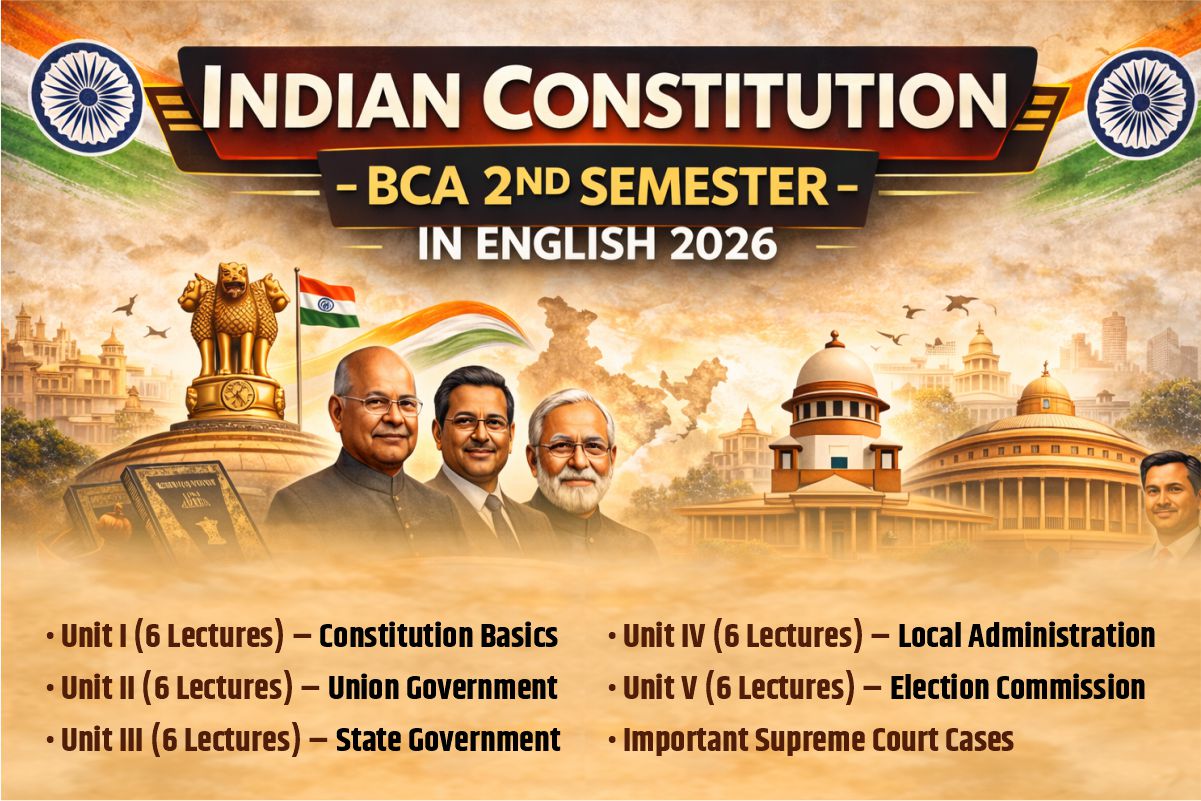
📘 Subject Details
Course Code: BCA-2006T
Paper: Indian Constitution
Credits: 2
Total Marks: 100 (External)
Total Lectures: 30
Type: Theory
🟢 UNIT I – CONSTITUTION BASICS
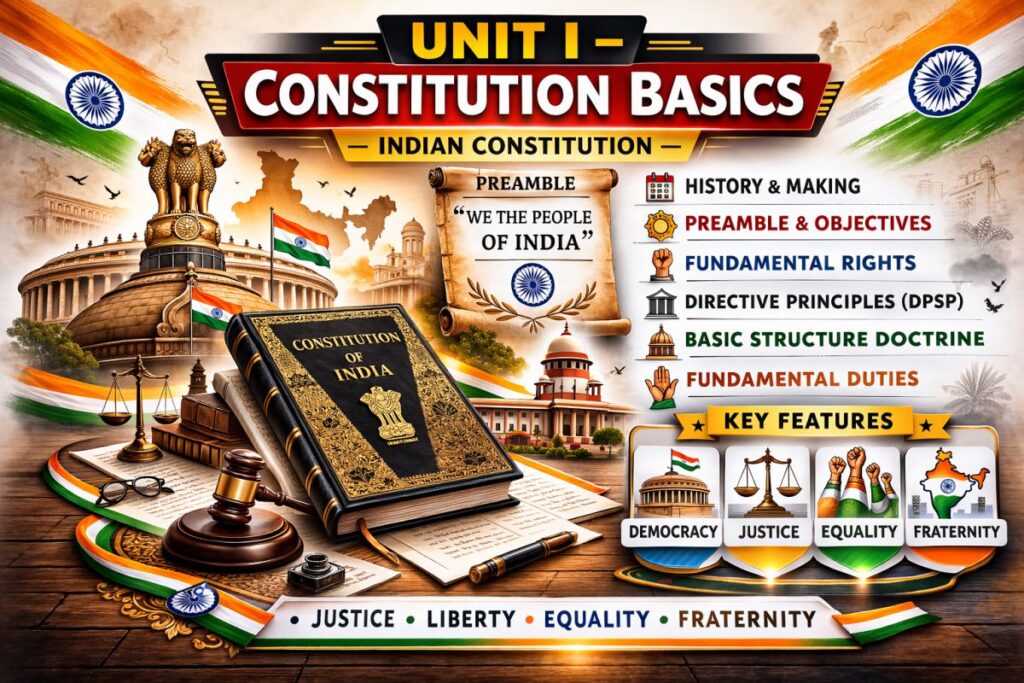
1️⃣ Introduction to the Indian Constitution
A Constitution is the supreme law of a country. It defines:
The structure of the government
Distribution of powers
Rights of citizens
Duties of the state
The Indian Constitution is the longest written Constitution in the world.
Key Features of the Indian Constitution
Written Constitution
Federal system with unitary features
Parliamentary form of government
Fundamental Rights
Independent Judiciary
Secular State
2️⃣ History of the Making of the Constitution
Important Events
1934 – Idea of Constituent Assembly proposed by M.N. Roy
1946 – Constituent Assembly formed
9 December 1946 – First meeting held
26 November 1949 – Constitution adopted
26 January 1950 – Constitution came into force (Republic Day)
Drafting Committee
Chairman: Dr. B.R. Ambedkar
Time Taken
2 years, 11 months, 18 days
Originally 395 Articles
Originally 8 Schedules
3️⃣ The Preamble ⭐ (Very Important)
The Preamble is the introductory statement of the Constitution.
It explains the philosophy and objectives of the Constitution.
It begins with:
“We, the People of India…”
Nature of India According to the Preamble
India is:
Sovereign
Socialist
Secular
Democratic
Republic
(Note: “Socialist” and “Secular” were added by the 42nd Amendment in 1976.)
Objectives of the Preamble
Justice (Social, Economic, Political)
Liberty (Thought, Expression, Belief, Faith, Worship)
Equality (Status and Opportunity)
Fraternity (Unity and Integrity of the Nation)
The Preamble is often called the “Soul of the Constitution.”
4️⃣ Basic Structure Doctrine ⭐ (Very Important)
The Basic Structure Doctrine states that:
Parliament can amend the Constitution, but it cannot destroy or alter its basic structure.
Important Case
Kesavananda Bharati v. State of Kerala (1973)
The Supreme Court held that certain features of the Constitution are fundamental and cannot be removed.
Examples of Basic Structure
Supremacy of the Constitution
Rule of Law
Judicial Review
Secularism
Federalism
Separation of Powers
Democracy
The list is not fixed. The Supreme Court decides it case by case.
5️⃣ Fundamental Rights ⭐ (Very Important)
Fundamental Rights are given in Part III (Articles 12–35).
They protect individual liberty and ensure equality.
Six Fundamental Rights
Right to Equality (Articles 14–18)
Right to Freedom (Articles 19–22)
Right against Exploitation (Articles 23–24)
Right to Freedom of Religion (Articles 25–28)
Cultural and Educational Rights (Articles 29–30)
Right to Constitutional Remedies (Article 32)
Dr. B.R. Ambedkar called Article 32 the
“Heart and Soul of the Constitution.”
Important Articles
Article 14 – Equality before Law
Article 19 – Freedom of Speech and Expression
Article 21 – Protection of Life and Personal Liberty
6️⃣ Fundamental Duties
Fundamental Duties are mentioned in Part IVA (Article 51A).
They were added by the 42nd Constitutional Amendment Act, 1976.
These duties remind citizens of their responsibilities toward the nation.
Examples
Respect the Constitution and National Flag
Protect the environment
Promote harmony
Safeguard public property
There are 11 Fundamental Duties at present.
7️⃣ Directive Principles of State Policy (DPSP)
Directive Principles are given in Part IV (Articles 36–51).
They guide the government in making laws and policies to establish a welfare state.
Features
Not enforceable by courts
Moral obligation on the State
Aim to promote social and economic democracy
Examples
Equal pay for equal work
Free legal aid
Promotion of education
Organization of Panchayats
⭐ Most Important Topics for Examination
Preamble
Fundamental Rights
Basic Structure Doctrine
These topics usually carry higher marks.
🟢 UNIT II – UNION GOVERNMENT
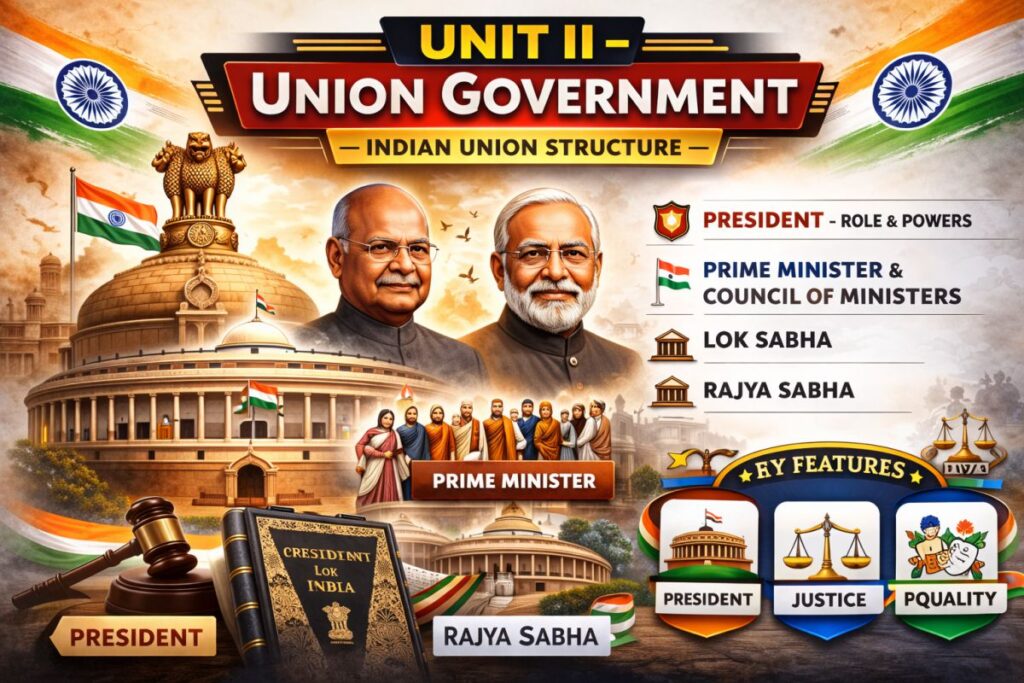
1️⃣ Structure of the Indian Union
India follows a Federal System with Unitary Features.
The Union Government (Central Government) works at the national level.
Three Organs of the Union Government
Executive – President, Prime Minister, Council of Ministers
Legislature – Parliament (Lok Sabha + Rajya Sabha)
Judiciary – Supreme Court
India follows a Parliamentary System of Government, where the real executive power is exercised by the Prime Minister and Council of Ministers.
2️⃣ President – Role and Powers ⭐ (Very Important)
The President of India is the constitutional head of the State.
Articles related to President: Articles 52–78
The President is elected indirectly by an Electoral College.
🔹 Role of the President
Head of the State
Supreme Commander of Armed Forces
Part of Parliament
Appoints Prime Minister
Although the President is the nominal executive, real powers are exercised on the advice of the Council of Ministers.
🔹 Powers of the President ⭐
1. Executive Powers
Appoints Prime Minister
Appoints Council of Ministers
Appoints Governors, Judges, CAG, Attorney General
Administers Union Territories
2. Legislative Powers
Summons and prorogues Parliament
Dissolves Lok Sabha
Gives assent to bills
Can return a bill (except Money Bill) for reconsideration
Promulgates Ordinances (Article 123)
3. Financial Powers
No Money Bill can be introduced without President’s recommendation
Causes the Union Budget to be laid before Parliament
4. Judicial Powers
Can grant pardon, reprieve, remission, or commute sentences (Article 72)
5. Emergency Powers
National Emergency (Article 352)
President’s Rule (Article 356)
Financial Emergency (Article 360)
👉 President’s powers are frequently asked in exams.
3️⃣ Prime Minister & Council of Ministers
🔹 Prime Minister
The Prime Minister is the real executive head of the government.
Appointed by the President.
Usually, the leader of the majority party in Lok Sabha becomes Prime Minister.
Powers of the Prime Minister
Selects Council of Ministers
Allocates portfolios
Advises President
Leader of Lok Sabha
Controls administration
Chief policy maker
🔹 Council of Ministers
Article 74 – There shall be a Council of Ministers to aid and advise the President.
Types of Ministers
Cabinet Ministers
Ministers of State
Deputy Ministers
The Council of Ministers is collectively responsible to Lok Sabha.
4️⃣ Lok Sabha (House of the People)
Lok Sabha is the Lower House of Parliament.
Key Features
Maximum strength: 552 members
Present strength: 543 elected members
Directly elected by the people
Tenure: 5 years
Powers of Lok Sabha
Can remove government through No-Confidence Motion
Controls money matters
Introduces Money Bills
More powerful than Rajya Sabha
5️⃣ Rajya Sabha (Council of States)
Rajya Sabha is the Upper House of Parliament.
Key Features
Maximum strength: 250 members
Permanent body (never dissolved)
One-third members retire every 2 years
Represents states
Powers of Rajya Sabha
Reviews and amends bills
Can delay ordinary bills
Cannot reject Money Bill (can only recommend changes)
⭐ Difference Between Lok Sabha and Rajya Sabha (Important)
| Basis | Lok Sabha | Rajya Sabha |
|---|---|---|
| Type | Lower House | Upper House |
| Election | Directly elected | Indirectly elected |
| Tenure | 5 years | Permanent body |
| Money Bill | Can introduce | Cannot introduce |
| Government Control | Can remove government | Cannot remove government |
| Strength | 543 members | 250 members (max) |
👉 Lok Sabha is more powerful in financial and executive matters.
⭐ Most Important Topics for Exam
Powers of the President
Role of Prime Minister
Difference between Lok Sabha and Rajya Sabha
🟢 UNIT III – STATE GOVERNMENT
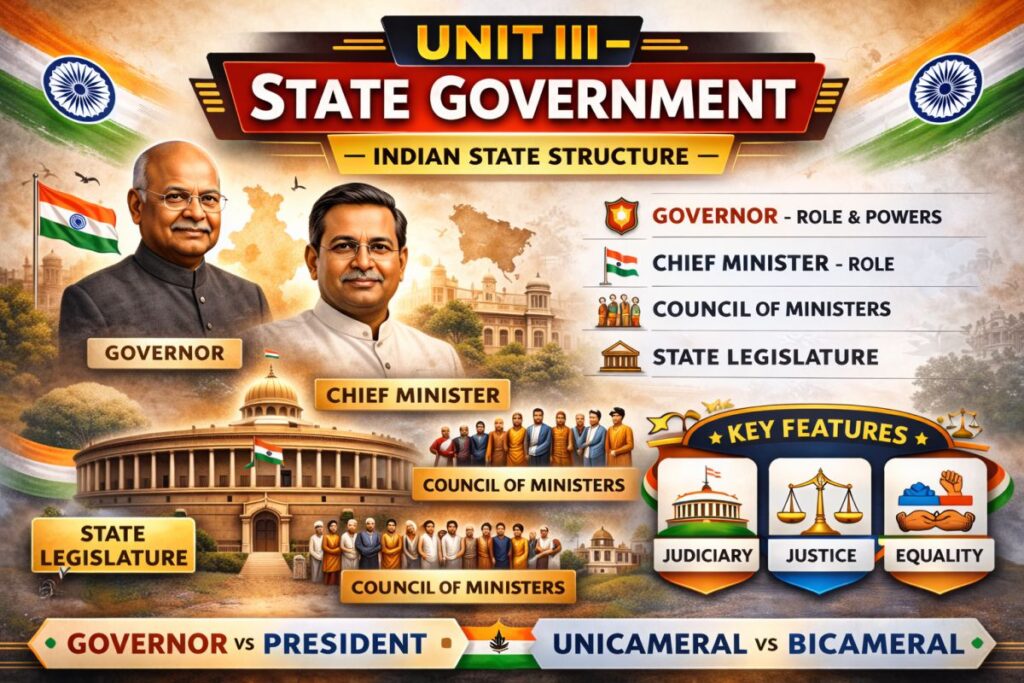
1️⃣ Introduction to State Government
India is a federal country, and powers are divided between:
Union Government
State Governments
Each state has its own government which works according to the Constitution.
Like the Union Government, the State Government also has three organs:
Executive – Governor, Chief Minister, Council of Ministers
Legislature – State Legislature (Legislative Assembly & Legislative Council, where applicable)
Judiciary – High Court
2️⃣ Governor – Role and Powers ⭐
The Governor is the constitutional head of the State.
Articles related to Governor: Articles 153–162
The Governor is appointed by the President of India.
🔹 Role of the Governor
Head of the State
Represents the President at the State level
Appoints the Chief Minister
Ensures constitutional governance in the State
The Governor acts on the advice of the Council of Ministers, except in certain discretionary matters.
🔹 Powers of the Governor
1️⃣ Executive Powers
Appoints Chief Minister
Appoints Council of Ministers
Appoints Advocate General
Appoints State Public Service Commission members
2️⃣ Legislative Powers
Summons and prorogues State Legislature
Dissolves Legislative Assembly
Gives assent to bills
Can reserve a bill for President’s consideration
Promulgates Ordinances (Article 213)
3️⃣ Financial Powers
Money Bill can be introduced only with Governor’s recommendation
Causes State Budget to be laid before Legislature
4️⃣ Judicial Powers
Can grant pardon, reprieve, remission under State laws
5️⃣ Discretionary Powers
Can recommend President’s Rule (Article 356)
Acts independently in certain situations
👉 Governor’s powers are frequently asked in exams.
3️⃣ Chief Minister ⭐
The Chief Minister is the real executive head of the State.
He/She is appointed by the Governor.
Usually, the leader of the majority party in the Legislative Assembly becomes Chief Minister.
Powers and Functions of the Chief Minister
Selects Council of Ministers
Allocates portfolios
Advises the Governor
Leader of Legislative Assembly
Coordinates government policies
Maintains communication between Governor and Council of Ministers
The Chief Minister is the most powerful person in the State Government.
4️⃣ Council of Ministers (State)
Article 163 – There shall be a Council of Ministers to aid and advise the Governor.
Types of Ministers
Cabinet Ministers
Ministers of State
Deputy Ministers
The Council of Ministers is collectively responsible to the Legislative Assembly.
If the Assembly passes a No-Confidence Motion, the Council must resign.
5️⃣ State Legislature
There are two types of State Legislatures:
Unicameral – Only Legislative Assembly
Bicameral – Legislative Assembly + Legislative Council
Most states have a unicameral legislature.
🔹 Legislative Assembly (Vidhan Sabha)
Lower House
Members directly elected
Tenure: 5 years
Controls State Government
Can remove government through No-Confidence Motion
🔹 Legislative Council (Vidhan Parishad)
Upper House
Permanent body
One-third members retire every 2 years
Exists only in some states
The Legislative Council has limited powers compared to the Assembly.
⭐ Important Differences (Governor vs President)
| Basis | President | Governor |
|---|---|---|
| Level | Union | State |
| Appointment | Elected indirectly | Appointed by President |
| Head of | Country | State |
| Ordinance Power | Article 123 | Article 213 |
| Emergency | Can declare National Emergency | Can recommend President’s Rule |
⭐ Most Important Topics for Exam
Powers of the Governor
Role of the Chief Minister
Difference between President and Governor
State Legislature structure
🟢 UNIT IV – LOCAL ADMINISTRATION
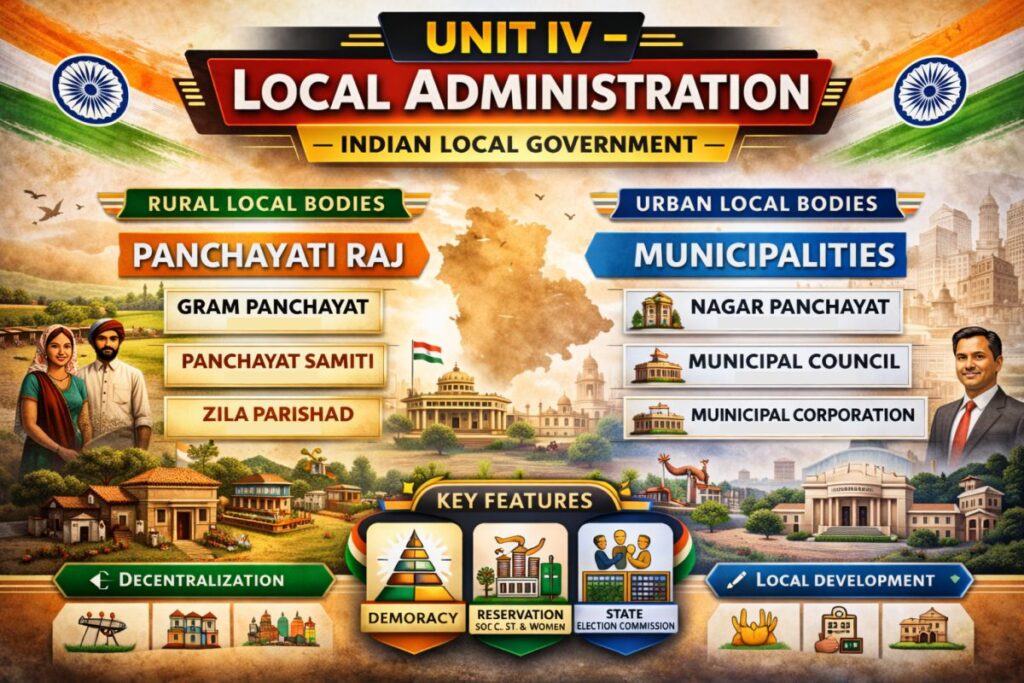
1️⃣ Introduction to Local Administration
Local Administration refers to the system of governance at the local level, such as villages, towns, and cities.
Its main objective is:
Decentralization of power
Local development
Public participation in governance
Local self-government strengthens democracy at the grassroots level.
2️⃣ Constitutional Status of Local Government
Local bodies were given constitutional status by:
73rd Constitutional Amendment Act, 1992 – Panchayati Raj (Rural Local Government)
74th Constitutional Amendment Act, 1992 – Municipalities (Urban Local Government)
These amendments added:
Part IX – Panchayats
Part IX-A – Municipalities
👉 These amendments are very important for exams.
3️⃣ Rural Local Government (Panchayati Raj System) ⭐
The Panchayati Raj system works in rural areas.
It has a three-tier structure:
1️⃣ Gram Panchayat (Village Level)
Lowest level
Headed by Sarpanch
Directly elected by villagers
Functions:
Maintain village roads
Sanitation
Drinking water
Local development programs
2️⃣ Panchayat Samiti (Block Level)
Works at block or tehsil level
Supervises Gram Panchayats
3️⃣ Zila Parishad (District Level)
Highest level at district
Coordinates development work in district
Important Features of Panchayati Raj
5-year tenure
Reservation for SC/ST and women
State Election Commission conducts elections
State Finance Commission reviews financial position
4️⃣ Urban Local Government (Municipalities) ⭐
Urban Local Bodies function in cities and towns.
They are of three types:
1️⃣ Municipal Corporation
For big cities
Headed by Mayor
Example: Delhi, Mumbai
2️⃣ Municipal Council
For medium towns
3️⃣ Nagar Panchayat
For transitional areas (village to town)
Functions of Urban Local Bodies
Water supply
Sanitation
Street lighting
Public health
Urban planning
Waste management
5️⃣ District Administration
District Administration is headed by:
District Collector / District Magistrate
Functions:
Law and order
Revenue collection
Implementation of government policies
Disaster management
The District Collector plays a very important administrative role.
⭐ Importance of Local Administration
Promotes democracy at grassroots level
Encourages public participation
Ensures faster development
Reduces burden on State Government
⭐ Most Important Topics for Exam
73rd and 74th Constitutional Amendments
Three-tier Panchayati Raj system
Difference between Rural and Urban Local Bodies
Functions of Municipal Corporation
🟢 UNIT V – ELECTION COMMISSION
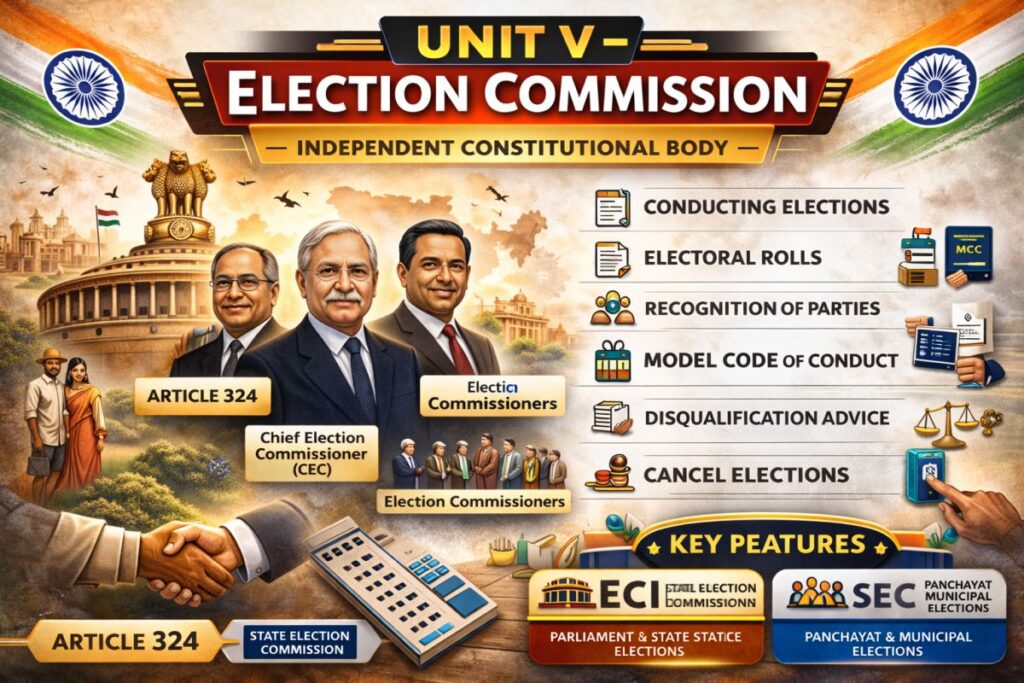
1️⃣ Introduction to the Election Commission
The Election Commission of India (ECI) is an independent constitutional body responsible for conducting free and fair elections in India.
It ensures democracy by supervising elections to:
Parliament
State Legislatures
President
Vice-President
2️⃣ Constitutional Provisions
The Election Commission is mentioned in:
👉 Article 324 of the Indian Constitution.
Article 324 gives the Commission the power of:
Superintendence, direction, and control of elections.
3️⃣ Composition of Election Commission
The Election Commission consists of:
Chief Election Commissioner (CEC)
Election Commissioners
Originally, it had only one member (CEC).
Now it is a multi-member body.
The President of India appoints the members.
4️⃣ Powers and Functions of the Election Commission ⭐
🔹 1. Conducting Elections
Conducts elections to Lok Sabha
Conducts elections to Rajya Sabha
Conducts State Assembly elections
Conducts Presidential and Vice-Presidential elections
🔹 2. Preparation of Electoral Rolls
Prepares and updates voter lists
Ensures no fake or duplicate voters
🔹 3. Recognition of Political Parties
Grants recognition to political parties
Allots election symbols
🔹 4. Model Code of Conduct (MCC)
Ensures political parties follow fair practices
Prevents misuse of government machinery
🔹 5. Advising the President or Governor
Advises on disqualification of members
🔹 6. Cancelling Elections
Can cancel election if malpractice or violence occurs
5️⃣ Independence of Election Commission
To ensure independence:
CEC can only be removed like a Supreme Court Judge
Salary and conditions cannot be altered to their disadvantage
Independent functioning from government interference
6️⃣ State Election Commission
Apart from the Central Election Commission, there is:
State Election Commission
It conducts elections for:
Panchayats
Municipalities
⭐ Importance of Election Commission
Ensures free and fair elections
Maintains democracy
Prevents electoral fraud
Protects voting rights
⭐ Most Important Topics for Exam
Article 324
Powers and Functions of Election Commission
Removal of Chief Election Commissioner
Difference between Election Commission & State Election Commission
⭐ Importance of Election Commission
Ensures free and fair elections
Maintains democracy
Prevents electoral fraud
Protects voting rights
⭐ Most Important Topics for Exam
Article 324
Powers and Functions of Election Commission
Removal of Chief Election Commissioner
Difference between Election Commission & State Election Commission
⭐ Short Difference (Important)
| Basis | Election Commission of India | State Election Commission |
|---|---|---|
| Level | National | State |
| Conducts | Parliament & State elections | Panchayat & Municipal elections |
| Article | 324 | 243K |